
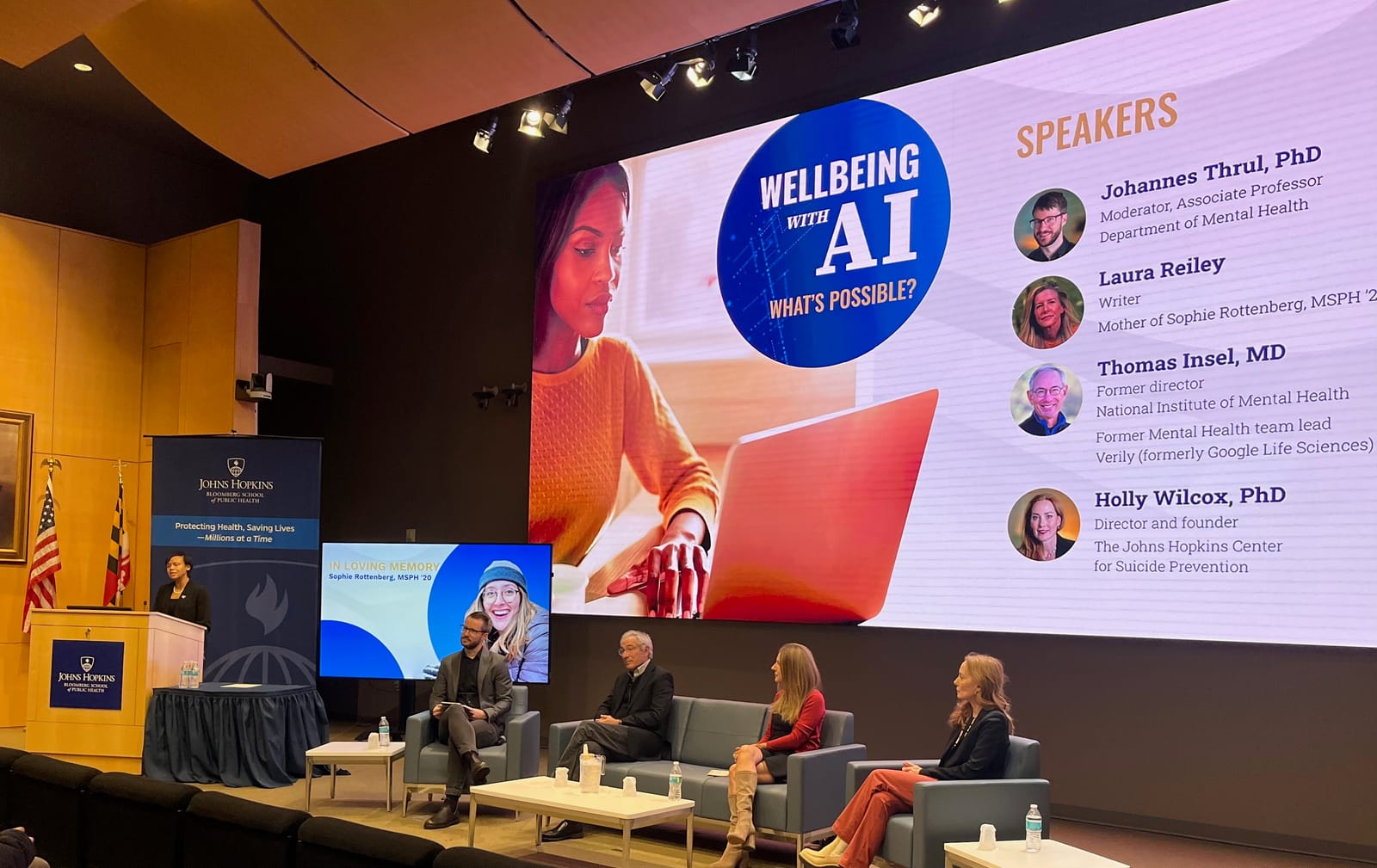
More and more people turn to AI chatbots for company, advice and emotional support. Research is still catching up with how those tools affect mental health, especially for people who are struggling. That gap was the focus of "Well-Being with AI: What's Possible?", a conversation hosted by the Department of Mental Health at the Johns Hopkins Bloomberg School of Public Health on February 2, 2026.
A conversation grounded in one family's experience
The event was held in loving memory of Sophie Rottenberg, a 2020 graduate of the Bloomberg School's MSPH program. Her mother, science writer Laura Reiley, has written publicly about Sophie, who had been confiding in an AI "therapist" in the months before she died by suicide. Reiley shared Sophie's story with the audience.
The Center is deeply grateful to Laura Reiley for her willingness to share something so personal, in the hope that it helps protect others.
The panel
Reiley was joined by:
- Dr. Thomas Insel, psychiatrist, neuroscientist and former Director of the National Institute of Mental Health, and
- Dr. Holly Wilcox, professor in the Department of Mental Health and founder and director of the Johns Hopkins Center for Suicide Prevention.
The discussion was moderated by Dr. Johannes Thrul, associate professor in the Department of Mental Health.
Holding two ideas at once
The conversation explored a tension many in public health now face. Digital tools could widen access to support, especially for people who find it hard to reach traditional care. At the same time, the most vulnerable users of generative AI need more attention to safety than they currently receive, and the pace of the technology is outrunning the research needed to guide it.
For suicide prevention, the questions are concrete. How should a chatbot respond when someone discloses thoughts of suicide? When should it encourage a person to reach out to people in their life, or to a crisis line? Who is responsible for testing those responses before tools are widely used?
Where the Center fits
A public health approach to suicide prevention looks for ways to make the settings around people safer, not only to treat individuals in crisis. As AI becomes part of those settings, the Center is committed to asking the same questions it asks of any intervention: Does it help? Is it safe? Does it work for the people at highest risk?
Conversations like this one, grounded in lived experience and open about what we do not yet know, are an important part of getting those answers right.
Center faculty in this story
-
 Holly C. Wilcox, PhD Director & Founder, Johns Hopkins Center for Suicide Prevention; Professor, Department of Mental Health
If you or someone you know is in crisis, call or text 988 for the Suicide & Crisis Lifeline — free, confidential, 24/7. Visit 988lifeline.org.